Pusoy Dos Rules: How to Play, Card Ranking and Combinations
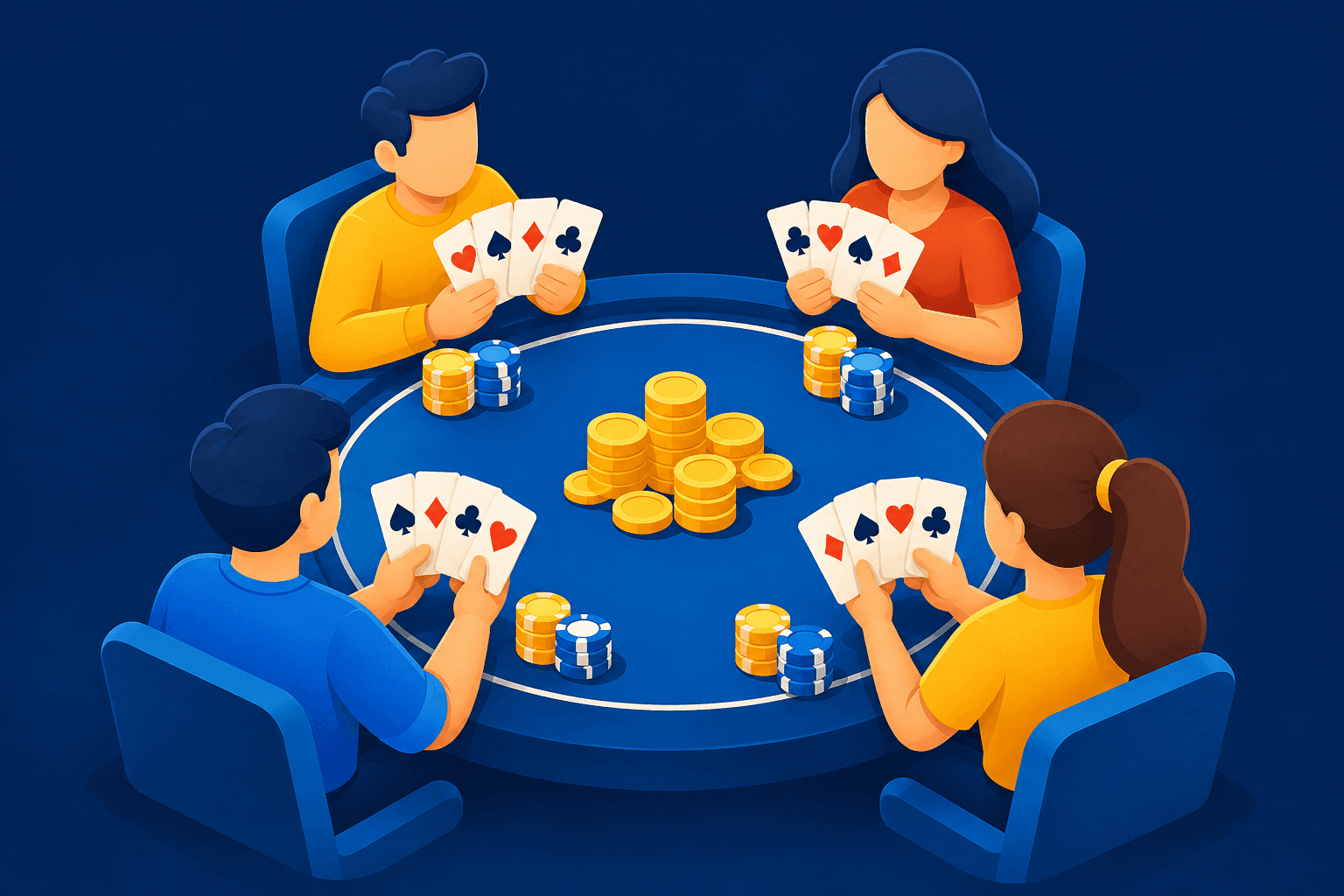
Pusoy Dos is Big Two. Four players get 13 cards each, the holder of the 3 of clubs starts, and everyone takes turns beating the last play with a higher combination of the same size or passing. The first player to empty their hand wins. What makes the Filipino game different from the international one is the suit order: diamonds are high and clubs are low, so the 2 of diamonds is the strongest single card in the deck.
That is the whole game in one paragraph. The rest of this page covers the details that decide actual hands: what counts as a legal combination, how ties are broken, what happens after a pass, and which rules you should agree on before the first deal, because they are not the same at every table.
Pusoy Dos in English, and Why It Is Not Plain Pusoy
The rule archive pagat.com, maintained by John McLeod, lists Pusoy Dos as "the usual name used in the Philippines" for Big Two, and credits Ruben Canlas Jr. for the translation "Poker Two". Wikipedia's Big Two entry adds that the game is called chikicha in other Philippine languages. Elsewhere you will see it as Big Deuce, dai di or capsa.
Plain Pusoy is a different game. In Pusoy you split 13 cards into three poker hands and compare them all at once; nobody takes turns. If that is the game your barkada plays, our Pusoy (Chinese Poker) rules and scoring guide covers it. This page is only about the shedding game.
Setup: Cards, Players and the First Play
- Deck: one standard 52-card deck, no jokers.
- Players: best with four, each playing alone. Wikipedia gives the range as two to four players, and pagat describes the two- and three-player setups covered further down.
- Deal: all 52 cards, 13 per player.
- Who starts: the player holding the 3 of clubs. The PinoyAI rules page, a Filipino Pusoy Dos project, says that opening play must include the 3 of clubs, either as a single or inside a pair, triple or five-card combination.
- Direction: PinoyAI plays clockwise. Pagat's base description plays anticlockwise and notes that many groups play clockwise. It changes nothing about the rules as long as everyone agrees.
Pagat also notes that many groups only use the 3 of clubs to open the first deal of a session; after that, the winner of each hand leads the next one.
How a Round Works: Beat It or Pass
Every play after the opener has to follow one rule: same number of cards, higher value. A single can only be beaten by a higher single, a pair by a higher pair, a triple by a higher triple. You cannot drop a triple on a pair or a straight on a triple.
Five-card plays are the one place where type matters. Any five-card combination can be beaten by a higher combination of the same type, or by any combination of a stronger type, so any flush beats any straight regardless of the cards in it.
On your turn you have two choices:
- Play a higher combination of the same size.
- Pass. You never have to beat a play just because you can. Holding a 2 back for later is often the right call.
Under pagat's base rules, passing does not lock you out. When your turn comes round again in the same sequence, you can still play. Some groups, which pagat traces to Indonesia, play that once you pass you are out until the next lead. Ask which rule the table uses.
Control
When every other player passes in a row, the last player who played takes control. The table is cleared and that player leads any legal combination, of any size, without having to beat anything. PinoyAI's rules add two points worth remembering: a player in control must lead and cannot pass, and control also passes to the next player when the previous player has just played their last card.
Card counts are public. Pagat states that everyone is allowed to know how many cards each opponent holds at any time, and that you must answer truthfully when asked.
Pusoy Dos Ranking: Cards and Suits
Card ranks, from lowest to highest:
3, 4, 5, 6, 7, 8, 9, 10, J, Q, K, A, 2
The 2 is the highest rank, which is where the name comes from. When two cards have the same rank, the suit decides:
| Philippine Pusoy Dos | International Big Two | |
|---|---|---|
| Suit order, lowest to highest | Clubs, spades, hearts, diamonds | Diamonds, clubs, hearts, spades |
| Highest single card | 2 of diamonds | 2 of spades |
| Lowest card, which opens | 3 of clubs | 3 of diamonds |
Pagat states the Philippine order directly, "diamonds, hearts, spades, clubs" from high to low, and notes that the 3 of clubs rather than the 3 of diamonds starts. PinoyAI lists the same order independently. If you learned Big Two from an international app, this is the rule most likely to cost you a hand.
Pusoy Dos Combinations, Lowest to Highest
| Combination | Cards | How ties are broken |
|---|---|---|
| Single | 1 | Rank first, then suit |
| Pair | 2 | Rank first; between equal pairs, the pair holding the higher suit wins |
| Triple (three of a kind) | 3 | Rank only |
| Straight | 5 | Five consecutive ranks, mixed suits; lowest five-card type |
| Flush | 5 | Five of one suit; beats any straight |
| Full house | 5 | Ranked by its triple; beats any flush |
| Four of a kind | 5 | Four equal cards plus any fifth card; ranked by the four |
| Straight flush | 5 | Five consecutive ranks in one suit; beats every other five-card play |
Three rules catch poker players out:
- There is no two pair. Two pairs together are not a legal play.
- Four of a kind needs a fifth card. Four equal cards on their own are not playable under pagat's base rules.
- A triple travels alone. You cannot add loose cards to it unless they turn it into a full house or four of a kind.
Two rankings that depend on the table
Flushes. PinoyAI ranks flushes by suit first, so a diamond flush beats any club flush, and uses the top card only when suits match. Pagat's base description does the same. Pagat also records groups that compare the highest card first, which it calls the usual Hong Kong version, and groups that compare card by card as in poker.
Straights with an ace or a 2. PinoyAI allows wrap-around straights such as A-2-3-4-5 and 2-3-4-5-6, still treats the ace and 2 as high cards, and names 3-4-5-6-7 as the lowest straight. Pagat lists at least six different ways groups rank straights that contain an ace or a 2, and some groups ban them outright. This is the rule most worth settling before money is involved.
How a Hand Ends and How the Winner Scores
Under pagat's base rules, play stops the moment one player runs out of cards. Nobody gets a last chance to beat the winning play.
Pagat records that the Philippine game normally uses positive points. The winner scores 1 point and nobody else scores. If the winning play contains a 2, the score doubles for each one:
| Deuces in the winning play | Points to the winner |
|---|---|
| None | 1 |
| One | 2 |
| Two | 4 |
| Three | 8 |
| Four | 16 |
Some tables keep playing until only one player is left holding cards. PinoyAI describes that format as a race for 1st to 4th place, and pagat gives a matching scale for it: 5 points for going out first, 3 for second, 1 for third, nothing for last.
International Big Two is scored the other way round, with penalty points for every card left in the losers' hands. Pagat's base version charges 1 point per card for up to 9 cards, 2 per card for 10 to 12, and 3 per card for a player who never played at all.
Pusoy Dos With 2 or 3 Players
Neither setup is standardised, which is exactly why search results disagree.
| Players | Cards per player | Unused cards | Notes from pagat.com |
|---|---|---|---|
| 3 | 17 | 1 | The last card goes face up to whoever holds the opening card |
| 3 (alternative) | 13 | 13 | A player who passes draws from the unused stock |
| 2 | 17 | 18 | Holder of the lowest dealt card starts |
| 2 | 21 | 10 | Same start rule |
| 2 | 13 | 26 | Same start rule; some groups make a player who passes draw |
With two players, the lowest card in play may not be the 3 of clubs, since that card could be in the unused stack. That is why pagat's two-player rule says the lowest dealt card starts.
Rules to Agree On Before the First Deal
Pagat's own summary of the game is blunt: "I have not seen any two independent descriptions of the rules that agree completely." These are the differences that change results.
| Question | Common answer | Where tables differ |
|---|---|---|
| Suit order | Clubs low, diamonds high | International apps use diamonds low, spades high |
| Who leads each deal | 3 of clubs | Many groups: the previous winner leads after the first deal |
| Can you play after passing? | Yes, on your next turn | Some groups: no, not until the next lead |
| Can the player in control pass? | No | Rarely disputed |
| Straights with A or 2 | Allowed, A and 2 still count high | At least six rankings on pagat; some ban them |
| Flush ranking | Suit first | Highest card first, or poker-style comparison |
| Four of a kind | Needs a fifth card | Some allow four cards alone as a separate type |
| When the hand ends | First player out ends it | Some play on until one player is left |
| Scoring | Winner scores, doubled per deuce | Penalty points per card left |
On an app or a real-money platform, the rules screen is the contract. Read it once before playing, especially the straight and flush rules.
Playing Pusoy Dos Online for Pesos
PAGCOR licenses operators, not individual card games, so there is no list of approved Pusoy Dos apps to check. What you can check is whether the exact domain you are playing on appears on PAGCOR's published lists. Our guide to spotting a genuinely PAGCOR-licensed casino walks through that check.
Among the PAGCOR-licensed platforms on our site, GameZone is the one built around Filipino card games. DigiPlus describes its GameZone tour as based on "traditional Filipino card games such as Tongits and Pusoy". Those public materials do not say whether that means 13-card Pusoy, Pusoy Dos or both, so check the lobby before you deposit. Our list of licensed platforms shows what else is available.
A few things to keep in mind:
- Free-chip apps are a different product. Social card apps that sell virtual chips are not licensed gambling platforms, and the chips do not turn back into pesos. Our Tongits guide explains the difference, and it applies to Pusoy Dos in the same way.
- On "daya" (cheating) claims: we found no public audit of how any operator shuffles or deals Pusoy Dos, so we cannot confirm or rule out any specific claim. In any four-player game, two players sharing information have an edge over the other two. A licensed platform at least gives you someone to complain to. An unlicensed one does not.
- The age limit is 21. PAGCOR's Responsible Gaming Code of Practice, version 6, says "persons younger than 21 years old are not allowed to play."
What Skill Can and Cannot Do
Pusoy Dos rewards decisions more than most Filipino card games. Keeping a 2 for the moment you need control, breaking up a hand so that no single card gets stuck at the end, and watching opponents' card counts all matter over a session. If you play Lucky 9, where decisions barely change the result, Pusoy Dos will feel very different.
It still has limits. A bad deal cannot be played into a good one, and in a four-player game you will lose most hands even when you play well. PAGCOR's own code requires operator advertising to "discourage the thought that skill and talent can change the result of the game or can assure a win", and that is the right way to approach it.
Set your budget before you sit down, use the platform's deposit limits, and stop after a losing session instead of raising the stakes. The tools for limits and self-exclusion are on our responsible gambling page, and PAGCOR's problem gambling helpline is (02) 8248-9568. For players 21 and over only.
Sources, checked 17 September 2026